
Collection: Spa Electrical
-
Transformer, Pentair, Minimax NT, 115v/230v, 40v, Commercial
Vendor:Pentair
471571Regular price $96.30Regular priceUnit price per$179.90Sale price $96.30Sold out -
Pentair 520973 IntelliChlor COMSYS-8 Commercial Salt Chlorine Generator, 40,000 Gallon
Vendor:Pentair
520973Regular price $14,566.50Regular priceUnit price per$23,306.40Sale price $14,566.50Sold out -
Transformer, Hydro-Quip, Universal, 115v, 24v
Vendor:Hydro-Quip
48-0099X-120Regular price $104.00Regular priceUnit price per$193.80Sale price $104.00Sold out -
Sold out
Control, TF-1 120V 1HP Package
Vendor:Allied Innovations
910800-001Regular price $44.20Regular priceUnit price per$92.30Sale price $44.20Sold out -
Relay, P&B, DPDT, 24VDC, 20A, Dust Cover
Vendor:Potter & Brumfield
KUHP-11D51-24Regular price $34.60Regular priceUnit price per$74.60Sale price $34.60Sold out -
Connector, PC Board, Top Entry, Modular Jack
Vendor:Horizon Spa & Pool Parts
5557969-1Regular price $11.10Regular priceUnit price per$24.80Sale price $11.10Sold out -
Rocker Switch SPST, 20A, 115v, large size
Vendor:Horizon Spa & Pool Parts
60-555-1615Regular price $15.20Regular priceUnit price per$35.70Sale price $15.20Sold out -
Rocker Switch SPST, 16A, 115v, small size
Vendor:Horizon Spa & Pool Parts
60-555-1610Regular price $14.50Regular priceUnit price per$33.50Sale price $14.50Sold out -
Sold out
Toggle Switch, DPDT, Center Off
Vendor:Horizon Spa & Pool Parts
60-555-1516Regular price $18.60Regular priceUnit price per$41.60Sale price $18.60Sold out -
Sold out
Toggle Switch, DPDT, 230v
Vendor:Horizon Spa & Pool Parts
60-555-1515Regular price $21.10Regular priceUnit price per$47.30Sale price $21.10Sold out -
Toggle Switch, Single Pole Double Throw, 115v
Vendor:Horizon Spa & Pool Parts
60-555-1505Regular price $22.40Regular priceUnit price per$49.10Sale price $22.40Sold out -
Adapter Cord Kit, P1/2 Speed, P2/2 Speed, Blower, Ozonator
Vendor:Hydro-Quip
60-355-1615Sold out -
Adapter Cord Kit, Hydro-Quip, P1/2 Speed, Ozonator
Vendor:Hydro-Quip
CORDKITRegular price $37.40Regular priceUnit price per$78.10Sale price $37.40Sold out -
Relay, TE Connectivity, S87R Series, DPDT, 20A, 12vdc
Vendor:Carlton-Bates
S87R11D2B1D1-12Regular price $41.70Regular priceUnit price per$87.60Sale price $41.70Sold out -
Relay, TE Connectivity, DPDT, 15A, 120v
Vendor:Carlton-Bates
K10P11A15-120Regular price $25.80Regular priceUnit price per$57.80Sale price $25.80Sold out -
Sold out
Cable Splice Kit, Brett Aqualine
Vendor:Brett Aqualine
990130-000Regular price $33.50Regular priceUnit price per$72.20Sale price $33.50Sold out


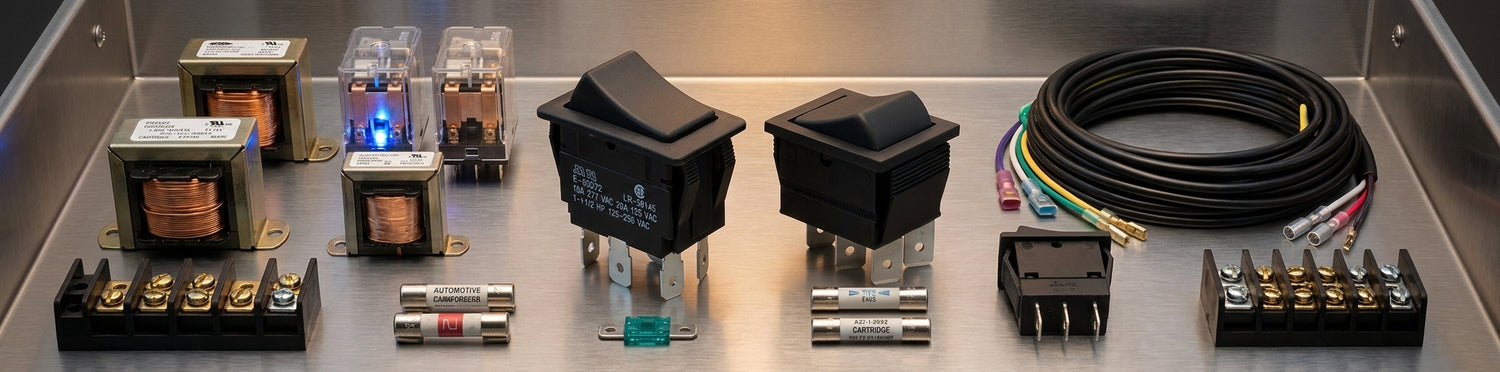
Spa electrical parts are what stand between you and a tub that boots up, holds heat, and switches loads on demand. Our spa electrical components collection covers the unglamorous parts that fail first when a hot tub starts misbehaving: fuses, relays, contactors, transformers, terminal blocks, GFCI components, cord sets, and the rocker, toggle, and slide switches that wire into spa pack control boards. Brands include Hydro-Quip, Balboa, Sundance, T-92, and other OEM-grade replacements.
A blown spa fuse is usually a symptom, not the disease — but it's a five-minute fix that can save a $400 control board if you catch it early. Common culprits: a 30A T-92 DPST relay welded by a surge, a 12V transformer that finally cooked after a decade of duty cycling, or a GFCI breaker that's been nuisance-tripping because the heater element is leaking to ground (heater swaps live in our Spa Heaters collection). Always pull the spa pack model number before ordering relays — Balboa BP packs, Hydro-Quip CS-series, and Sundance LX systems use different relay footprints. UL 1563 is the safety standard for hot tub electrical components if you want to confirm a replacement meets the same certification.
When you're sourcing a spa transformer, match the input voltage (115V, 230V, or dual), output voltage (typically 12V or 24V for spa light and ozonator circuits), and connector style — molded plugs are common on Hydro-Quip wet-end transformers, while bare-wire or screw-terminal styles are standard on Balboa. Receptacles, cord sets, and adapter cords for pump and accessory ports are also stocked here; for the spa pack the receptacles plug into, see our Spa Packs collection. Balboa's service portal publishes color-coded receptacle charts for every BP-series pack.
Shop the full spa electrical lineup below — fuses, relays, transformers, switches, and cord sets all ship from one of our ten U.S. warehouses so the tub is back in service before the weekend.