
Collection: Spa Sensors
-
Thermostat, Invensys, 1/4", 6", SPST, 25A, Short Leads
Vendor:Invensys Appliance Controls
275-2568-00Regular price $42.70Regular priceUnit price per$88.20Sale price $42.70Sold out -
Hi-Limit Sensor, Sundance Sweet Water, Thermo Disk
Vendor:Thermodisc
2-05-0110Regular price $22.50Regular priceUnit price per$48.70Sale price $22.50Sold out -
Thermostat, Tecmark, Electronic, 1A, 115v, 100-120 Deg
Vendor:Tecmark Corporation
ETS1007-12000Regular price $75.60Regular priceUnit price per$145.80Sale price $75.60Sold out -
Thermostat, Tecmark, Solid State, 5/16", 24", SPST, 24v, 1A, Generic
Vendor:Tecmark Corporation
ETS1000-02402LPRegular price $62.30Regular priceUnit price per$125.50Sale price $62.30Sold out -
Sensor, Temperature, Pentair Minimax/PowerMax
Vendor:Pentair
470180Regular price $48.50Regular priceUnit price per$100.90Sale price $48.50Sold out


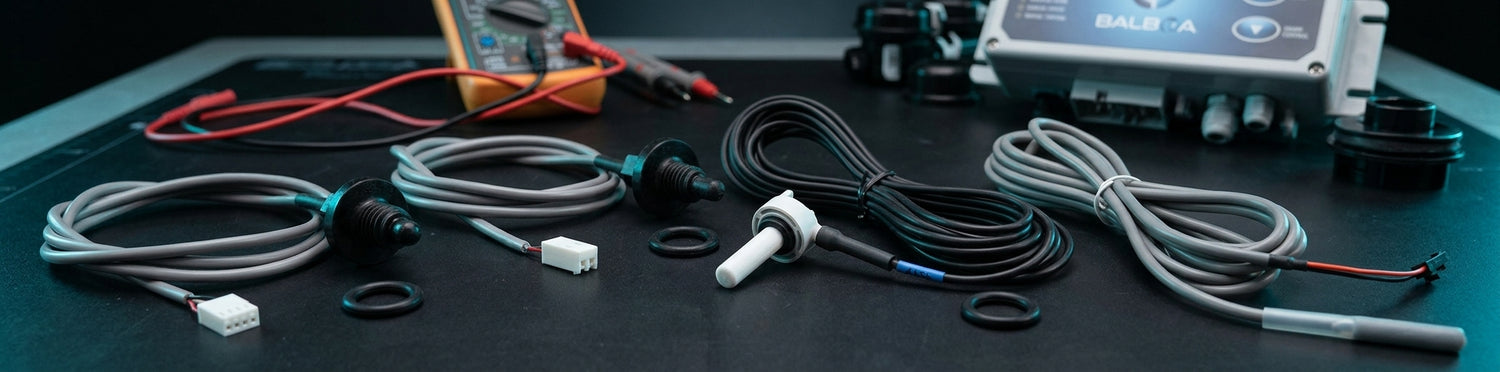
A failed spa sensor is the single most common reason a hot tub throws an error code, locks out the heater, or refuses to maintain temperature. Our spa sensors collection covers the full diagnostic chain — temperature sensors, hi-limit (high-temperature cutoff) sensors, thermistors, mechanical thermostats, and water-level sensors — for Balboa, Sundance, United Spas, Hydro-Quip, Gecko, and Len Gordon control systems, including the M7 sensors used in modern BP-series spa packs.
If your spa is reading OH, OHH, OHS, SnA, SnB, dr, or a similar fault, replacing the temperature/hi-limit sensor pair is almost always the fix before tearing into the spa pack itself. Modern Balboa BP packs use M7 sensors — twin probes molded into a single cable with a JST connector that snaps into the pack — and these are sold in cable lengths from 12" to 96" depending on your install. Balboa's M7 tech reference explains the dual-sensor diagnostic logic. Older two-wire sensors still ship with Sundance 800, Gecko TSC, and United Spas controllers — match the connector style (box-end, curled finger, two-pin) and cable length when ordering. For the heater tube itself, see our Spa Heater Element collection.
Diagnosing a spa sensor failure is usually straightforward: pull both temp and hi-limit, measure resistance against the pack manufacturer's curve (typically around 10kΩ at 77°F for thermistor-style sensors), and replace any sensor more than 5–10% out of spec. Always replace the sensor pair together — when one fails, the other is usually close behind. For sensors that mount inside the heater housing, swap the heater gasket and o-ring at the same time; spares live in our Spa Heater Parts collection.
Shop the full spa sensor and thermistor lineup below — temp sensors, hi-limit sensors, thermistors, and thermostats all ship from one of our ten U.S. warehouses for fast turnaround on a tripping heater.